Dussehra 2026: Date, Story, Significance and How It's Celebrated
By Archit Bhargava ·
Dussehra, also called Vijayadashami, celebrates the victory of good over evil. It marks Lord Rama's defeat of Ravana and Goddess Durga's triumph over the demon Mahishasura, and falls on the tenth day after the nine nights of Navratri.
Quick facts
- Dussehra 2026 date: Tuesday, 20 October 2026
- Also known as: Vijayadashami, Dasara, Bijoya Dashami (in Bengal)
- Hindu calendar: Dashami (tenth day) of the bright half of the month of Ashvin
- Comes after: Sharad Navratri, 11 to 19 October 2026
- Celebrates: Rama's victory over Ravana, and Durga's victory over Mahishasura
- Key traditions: Ramlila, Ravan Dahan, Shami puja, Ayudha puja, Durga idol immersion
When is Dussehra in 2026?
Dussehra 2026 is on Tuesday, 20 October, the day after the nine nights of Navratri end. It is observed on the Dashami tithi of the bright fortnight of Ashvin, so the date moves each year with the lunar calendar, usually landing in late September or October. Auspicious timings, such as the afternoon Vijay muhurat, vary by city, so check your local panchang if you are planning a puja.
What does Dussehra mean?
The name comes from the Sanskrit dasha (ten) and hara (defeat or removal), often read as the defeat of ten-headed Ravana. Vijayadashami means "the tenth day of victory." Many people see Ravana's ten heads as ten human failings, such as ego, anger, greed, lust and jealousy, which makes the festival as much about overcoming them in ourselves as about a battle long ago.
Why is Dussehra celebrated?
Rama's victory over Ravana
In the Ramayana, Ravana, the king of Lanka, abducted Sita. Rama, with his brother Lakshmana, Hanuman and the vanara army, crossed to Lanka to bring her back. After a long battle, Rama killed Ravana on the tenth day, which is celebrated as Dussehra. About twenty days later, his return to Ayodhya is celebrated as Diwali.
Durga's victory over Mahishasura
In eastern India the day belongs to Goddess Durga. The buffalo demon Mahishasura could not be defeated by any god, so the gods combined their powers to create Durga, who fought him for nine days and nights and slew him on the tenth. Navratri honours those nine days, and Vijayadashami her victory.
The Pandavas and the Shami tree
The Mahabharata tells how the Pandavas hid their weapons in a Shami tree during their year in disguise and recovered them on Vijayadashami. That is why many families worship the Shami tree on Dussehra.
What is Ravan Dahan?
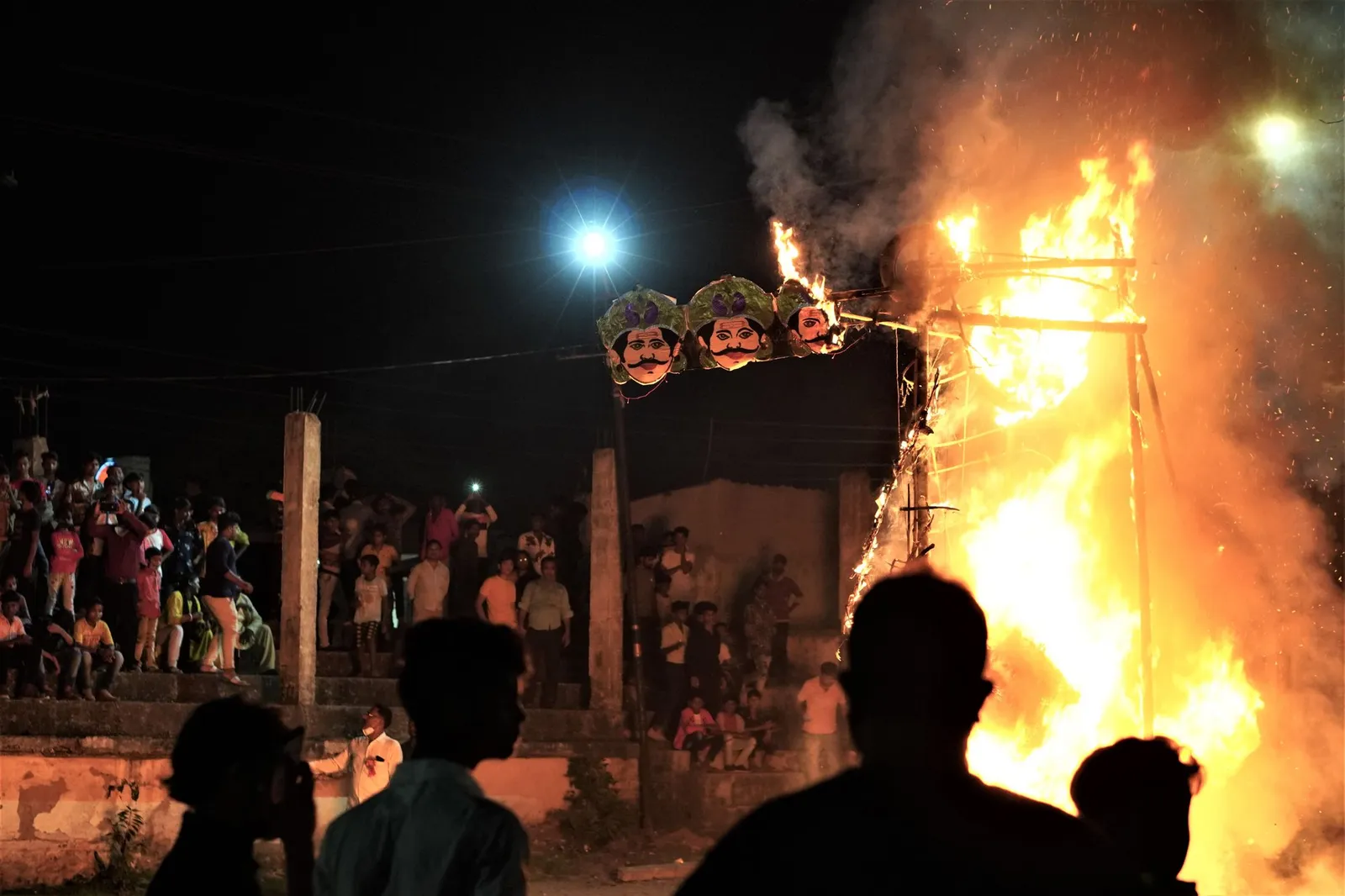
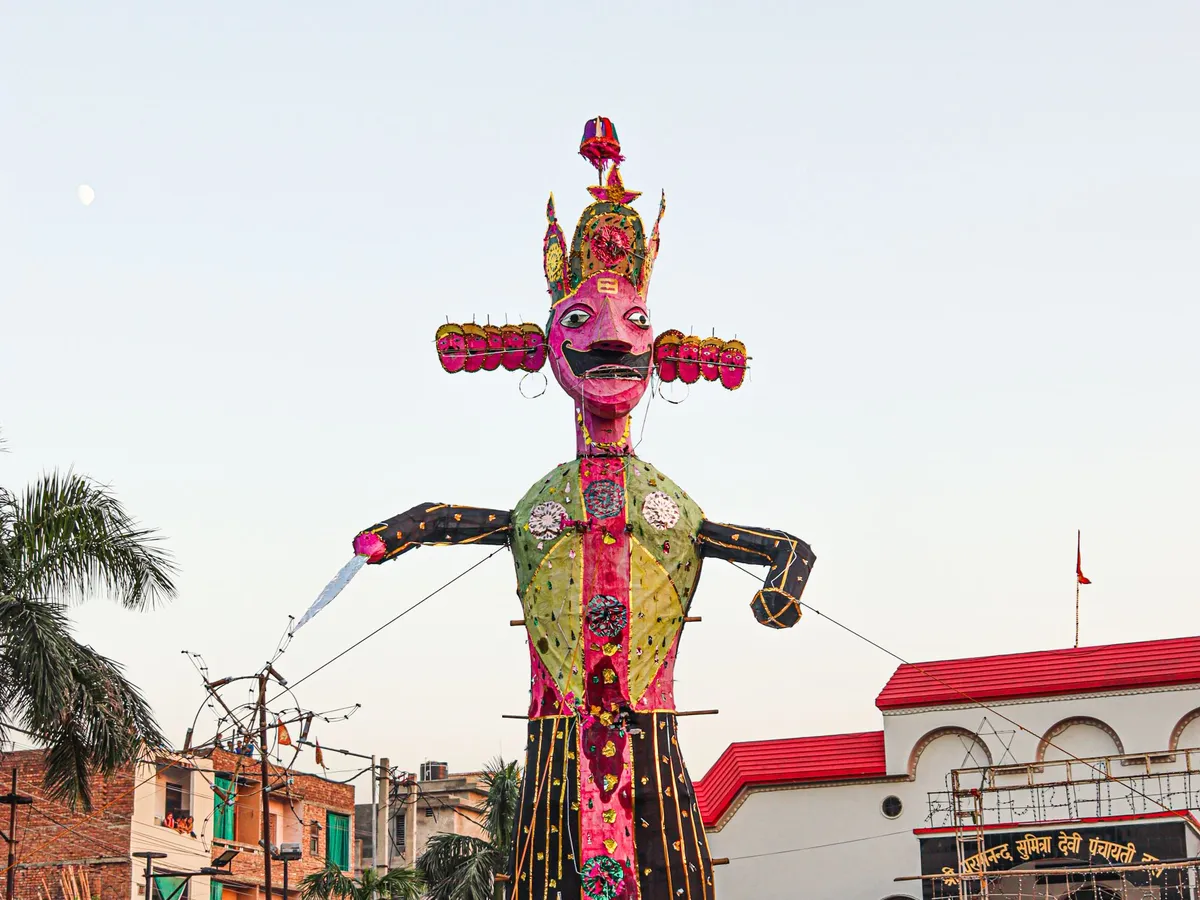
Ravan Dahan is the burning of giant effigies of Ravana, usually alongside his brother Kumbhakarna and son Meghnad. The effigies, often tens of feet tall, are built from bamboo and paper and packed with fireworks. At sunset on Dussehra, an actor playing Rama shoots a flaming arrow and the effigies go up in flames as crowds cheer.
It is the finale of Ramlila, the open-air plays that retell the Ramayana night after night during Navratri across North India. Delhi's Ramlila grounds and the Kota Dussehra fair in Rajasthan are among the best known.
How is Dussehra celebrated across India?
- North India: Ramlila performances through Navratri, ending in Ravan Dahan on Dussehra evening.
- West Bengal, Assam and Odisha: Bijoya Dashami ends Durga Puja. Durga idols are immersed in rivers, married women play sindoor khela, and families visit each other with sweets.
- Mysuru, Karnataka: Mysuru Dasara is a ten-day royal celebration with the illuminated Mysore Palace and the Jamboo Savari elephant procession on Vijayadashami.
- Kullu, Himachal Pradesh: Kullu Dussehra begins on Vijayadashami and lasts a week, as village deities are carried in procession to the Dhalpur grounds.
- Bastar, Chhattisgarh: Bastar Dussehra is one of the longest festivals in India, lasting around 75 days and centred on the goddess Danteshwari rather than Rama.
- Maharashtra: People exchange apta leaves as "gold" (sona), wishing each other prosperity.
- South India: Ayudha Puja honours tools, vehicles and instruments of work, and in Kerala, Vidyarambham sees young children write their first letters on Vijayadashami.
Dussehra traditions and rituals
- Shami puja: worshipping the Shami tree and exchanging its leaves for good fortune.
- Shastra or Ayudha puja: cleaning and worshipping weapons, tools, books and vehicles.
- New beginnings: Dussehra is considered one of the most auspicious days of the year to start a new venture, buy a vehicle or gold, or begin learning.
- Durga visarjan: the immersion of Durga idols at the end of Durga Puja.
- Visiting family: greeting elders, exchanging sweets and seeking blessings.
What food is eaten on Dussehra?
In Gujarat, Dussehra morning means jalebi and fafda, and queues outside sweet shops start early. In Bengal, Bijoya is marked with sweets such as rasgulla, sandesh and narkel naru. Across India, festive sweets are shared with family and neighbours.
Dussehra wishes to send
- "May the victory of good over evil fill your life with courage and light. Happy Dussehra!"
- "As Ravana's effigy burns, may every worry and negativity in your life burn with it. Happy Vijayadashami!"
- "Wishing you the strength of Rama and the blessings of Maa Durga this Dussehra."
- "May this Dussehra mark the start of something new and wonderful for you and your family."
Frequently asked questions
Is Dussehra the same as Vijayadashami?
Yes. Dussehra and Vijayadashami are the same festival. Dussehra is the common name in North India, while Vijayadashami is used widely in the south and in Bengal, where it is also called Bijoya Dashami.
What is the difference between Dussehra and Diwali?
Dussehra celebrates Rama's victory over Ravana. Diwali, about twenty days later, celebrates his return to Ayodhya, when the people lit lamps to welcome him home.
Why is Ravana's effigy burned on Dussehra?
Burning Ravana's effigy symbolises the destruction of evil and of the ego, anger and greed his ten heads represent. It is the climax of the Ramlila story.
Why is Dussehra celebrated after Navratri?
Navratri's nine nights honour Goddess Durga's battle with Mahishasura. Her victory on the tenth day, and Rama's victory over Ravana, are both celebrated on Vijayadashami.
This article was drafted with the help of AI and reviewed and edited by Archit Bhargava.
Make a card for Dussehra
Design and send one in a few minutes.